Description
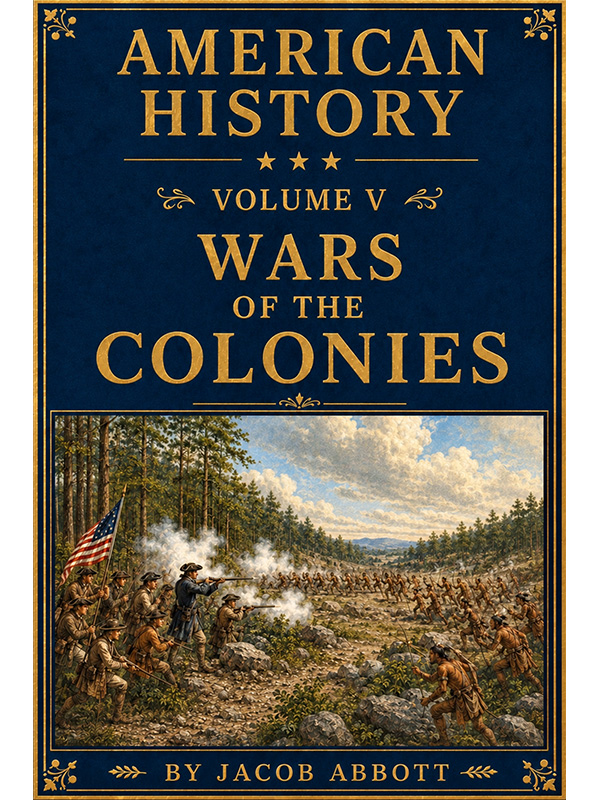
By Jacob Abbott. Enter the dangerous and turbulent world of colonial America in this vivid account of the wars and conflicts that shaped the future of the American colonies.
In American History: Volume V—Wars of the Colonies, celebrated historian Jacob Abbott recounts the dramatic military struggles that engulfed North America during the colonial era. Combining vivid storytelling with historical insight, Abbott brings to life the battles, frontier dangers, rival empires, and political conflicts that tested the strength and survival of the American colonies long before the Revolution.
Readers are transported into the wilderness frontiers, fortified settlements, and contested territories of colonial North America, where British, French, Spanish, and Native American forces competed for power and influence. The narrative vividly recreates the atmosphere of frontier warfare, including raids, sieges, military expeditions, naval struggles, and the constant dangers faced by settlers living along unstable borders.
Abbott explores the major colonial conflicts that shaped early American history, including wars between European empires fought on American soil and the growing military experience of the colonies themselves. Readers encounter famous historical figures, colonial leaders, soldiers, scouts, and frontiersmen as the colonies became increasingly drawn into global struggles for empire.
The book also highlights the hardships of colonial life during wartime—isolated settlements under threat, dangerous frontier conditions, and the courage required to survive amid violence and uncertainty. Themes of perseverance, ambition, rivalry, survival, and political change run throughout the narrative, offering readers insight into the forces that prepared the colonies for eventual independence.
Written in Abbott’s clear and engaging style, Wars of the Colonies transforms complex historical events into a compelling and accessible narrative suitable for younger readers and general audiences alike. More than a military history, it is a portrait of colonial America during an age of conflict and expansion.
This carefully restored reprint revives a classic historical work for modern readers interested in colonial America, frontier warfare, and the origins of the United States.
About the author: Jacob Abbott (1803–1879) was an American educator, historian, and prolific writer best known for his popular biographies and historical works for general readers and young audiences. He authored hundreds of books, including the celebrated Makers of History series, helping introduce generations of readers to world history through lively and accessible storytelling.
Contents
CHAPTER I: The Thirteen Colonies: Subject of the Volume.—Number of the Colonies.—Recapitulation.—Virginia, 1607.—New York, 1614.—Massachusetts, 1620.—New Hampshire, 1623.—New Jersey, 1624.—Delaware, 1627.—Maryland, 1633.—Connecticut, 1635.—Rhode Island, 1635.—North Carolina, 1650.—South Carolina, 1670.—Pennsylvania, 1682.—Georgia, 1733.—The Three Forms of Colonial Government.—The Charter Colonies.—The Royal Colonies.—The Proprietary Colonies
CHAPTER II: The Pequot War: The Connecticut Indians.—The Narragansetts.—The Pequots.—English Settlements.—The Pequot Country.—Origin of the Quarrel with the Pequots.—Case of Captain Stone and His Party.—The Indian Account of the Affair.—Treaty Made.—Wampum.—Cunning of the Narragansetts.—New Difficulties.—The Oldham Affair.—Demands of Satisfaction.—Expedition of Captain Endicott.—Captain Endicott at Block Island.—The Expedition Touches at the Fort at Saybrook.—The Expedition in the Thames.—A Parley.—Landing of the English.—The Pequots Effectually Aroused.—Desperate Hostilities of the Pequots.—Condition of the Settlements up the River.—Appeal to the Government of Massachusetts
CHAPTER III: End of the Pequot War: Preparations for the Final Struggle.—Indian Auxiliaries.—The Commander.—The Rendezvous.—The Voyage.—Arrival of the Expedition at Fort Saybrook.—The Indians Put to the Test.—The Prisoner Kiswas.—Dreadful Fate of Kiswas.—Rescue of the Two Captive Girls.—Manner in Which the Rescue was Effected.—The Girls’ Account of Their Adventures.—Subsequent Adventures of the Two Girls.—Consultations in Respect to the Plans of the Campaign.—The Prayers of the Chaplain.—The Expedition Sets Sail.—Canonicus and the Narragansetts.—News from the Massachusetts Division.—The Expedition Moves On.—Fort Nehantic.—The March Continued.—Passing the Pequot Frontier.—The Halt at Porter’s Rocks.—The Night in Camp.—Advance of the Attack.—The Attack.—Condition of the English Troops after the Battle.—The Wounded Men.—The English Regain Their Ships.—Return to Fort Saybrook.—End of the Pequots.—Sassacus
CHAPTER IV: War with King Philip: Philip’s Family and Name.—King Philip Makes Professions of Friendship.—Ten Years of Peace.—Signs of a Gathering Storm.—Frivolous Complaints of the Plymouth Authorities.—General Relations of the Indian and English Settlements.—John Sassamon.—Indian Interpreters.—Mt. Hope.—Sassamon’s Warning.—The Fate of Sassamon.—Arrest of the Supposed Murderers.—The Indictment.—Result of the Trial.—The Outbreak.—Incidents of the War.—The Fortune of War Is against the Indians.—The Great Swamp Fight at South Kingston.—The Summer of 1676.—Philip Is Betrayed.—Philip’s Last Hiding Place.—The Death of Philip.—Contemporaneous Account of the Transaction.—Trophies of the Fight.—Dreadful Character of the War
CHAPTER V: The Lakes and the Mississippi: French Settlements in Canada.—Face of the Country on the Northern Frontier.—Rapid Advance of the French Settlements.—Friendly Intercourse with the Indians.—The Missions.—Samuel Champlain.—Progress of the French Settlements toward the West.—The Fur Trade.—Reports about the Great River.—The Governor Plans an Expedition.—Sailing of the Expedition.—Father Marquette’s Account of His Adventures.—The Wild Oats.—Discouragements.—Farther Progress of the Expedition.—Crossing the Portage.—Voyage on the Wisconsin.—Discovery of the Mississippi.—Progress down the River.—An Indian Village.—Friendly Relations Established with the Indians.—Reception by the Sachem.—Farther Progress of the Expedition.—Return of the Expedition.—Father Marquette Receives His Reward
CHAPTER VI: King William’s War: Growth and Extension of the French Settlements.—Permanent Condition of Hostility.—King William’s War.—Plans of the Campaign on the Part of the French.—Proposed Attack upon New York.—Failure of the Plan.—The Expedition against Schenectady.—Surprise and Massacre of the Inhabitants.—Final Result of the Expedition.—Other Expeditions.—Effects of These Expeditions on the Indians.—Excitement in the English Colonies.—Plans of the Campaign.—Preliminary Expeditions.—Treachery of Major Waldron.—The Indians’ Plan for Revenge.—Success of the Plot.—Indian Ideas of Executing Justice on a Criminal.—The Race not Always to the Swift, nor the Battle to the Strong.—Advance of the Land Expedition.—Disastrous Termination of the Expedition.—Relief for the Canadian Governor.—Situation of Quebec.—Preparations for Defense.—The Town Summoned to Surrender.—Reply to the Summons.—The French Open Fire.—The Attack upon the Town.—Failure of the Plan.—Disasters Attending the Return of the Fleet.—End of the War
CHAPTER VII: Queen Anne’s War: Entanglement of the Colonies in European Politics.—The Accession of Queen Anne.—The Spanish Succession.—Offered Truce.—The Deerfield Expedition.—The Massacre.—Sequel of the Story.—Attack upon Haverhill.—The Assault.—Narrow Escapes.—Kindness to a Captive Girl.—Acadia.—Preparations for a New Invasion of Canada.—The Naval Force.—The Land Force.—Departure of the Expedition.—Preparations Made in Canada.—Confidence of the English Commander.—Disaster.—Total Failure of the Expedition.—End of the War
CHAPTER VIII: George Washington: Third French War.—The Final Struggle.—Washington.—Origin of the Quarrel.—Negotiations.—Washington Sent on an Embassage.—Transactions at the Fort.—The Return of Washington’s Party.—Division of the Party.—Return to Virginia.—Crossing the Allegheny.—Safe Arrival at Last.—Difficulties and Delays.—Firm Attempts to Take Possession of the Country.—Fort Duquesne.—General Braddock.—Arrival of the Troops.—Preparations for the Campaign.—Washington Joins the Expedition.—The First Stage of the March.—The Camp at Fort Cumberland.—The Indian Auxiliaries.—Braddock’s Unpopularity.—The March Rebuked.—Double Crossing of the River.—The Attack.—Carnage and Rout.—Retreat of the Army
CHAPTER IX: The Conquest of Canada: Slow Progress of the War.—Despondency of the Canadian Government.—The Marquis de Montcalm.—Grand Naval Expedition.—Preparations for Entering the River.—Situation of Quebec.—Advance of the Fleet.—The Proclamation.—Cannonading in the Harbor.—The French Fire-Ships.—Reconnoitering Party.—Attack at the Mouth of the Montmorency.—Sickness of General Wolfe.—Preparations for Carrying the New Plan into Effect.—The Attack.—Curious Coincidence.—Calmness and Composure of General Wolfe.—The Landing.—Advance of the French to Meet the Enemy.—The Battle.—Death of Both the Generals after the Battle.—Message from the Governor.—Proposed Capitulation.—The Ultimatum.—The Town Surrendered.—Further Continuance of the War
CHAPTER X: Pontiac: Cession of Canada to the English.—Taking Possession of the Country.—Pontiac.—First Interview with Pontiac.—Moderation of Major Rogers.—Pontiac’s Decision.—Ideas and Intentions of Pontiac.—The English Take Possession.—Pontiac Changes His Policy.—Progress of the Conspiracy.—Pretended Revelation from Heaven.—Concerted Attack upon the English Stations.—Stratagems.—The Mackinaw Game of Ball.—Design of the Indians.—Success of the Stratagem.—Detroit.—Construction of the Place.—Plan of Attack Concerted by the Indians.—Discovery of the Plot.—The Plot Defeated.—Attempts to Relieve the Garrison.—End of the War.—Conclusion