Description
By Paul du Chaillu. Journey deep into the heart of nineteenth-century equatorial Africa in this remarkable tale of exploration, adventure, and cultural encounter.
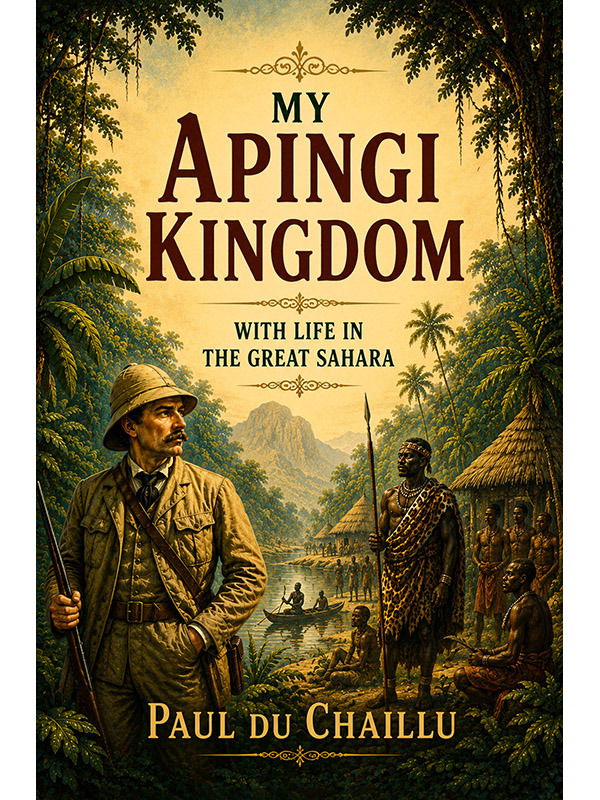
In My Apingi Kingdom, famed explorer Paul du Chaillu recounts his extraordinary experiences among the Apingi people of Central Africa during his travels through regions then little known to the Western world. Combining memoir, travel narrative, adventure, and ethnographic observation, this classic work offers readers a vivid firsthand account of African life, wilderness travel, and exploration during the great age of discovery.
Drawing upon his journeys through the forests and river systems of equatorial Africa, du Chaillu describes his interactions with the Apingi and neighboring peoples, whose societies, customs, leadership, ceremonies, and daily lives fascinated nineteenth-century readers. The narrative vividly recreates the atmosphere of tropical forests, remote villages, river expeditions, dangerous travel, hunting expeditions, and encounters with wildlife in some of the most inaccessible regions of the African continent.
Du Chaillu’s lively storytelling captures both the excitement and the hardships of exploration. Readers accompany him through difficult terrain, moments of danger, cultural misunderstandings, and extraordinary adventures in lands far removed from the industrialized world of Europe and America. Alongside tales of travel and survival, the book preserves valuable descriptions of local traditions and ways of life observed during his journeys.
Written in an engaging and highly readable style, My Apingi Kingdom stands as both an adventure narrative and a historical document of nineteenth-century exploration and cross-cultural encounter. Themes of curiosity, endurance, discovery, and human interaction run throughout the narrative, offering readers insight into the era of African exploration and the perspectives of the time in which the book was written.
This carefully restored reprint revives a fascinating classic of African travel literature for modern audiences. Ideal for readers interested in exploration history, Central Africa, nineteenth-century travel writing, and wilderness adventure, it remains a compelling journey into a world once largely unknown to Western readers.
* This new edition includes a new introduction, an author biography, and digitally restored illustrations reproduced from the earliest available editions.
About the author: Paul Du Chaillu (1831?-1903) was a French-American explorer, zoologist, anthropologist, and travel writer best known for his pioneering expeditions into Equatorial Africa during the mid-nineteenth century. He became internationally famous after publishing vivid accounts of his travels among the forests and peoples of West and Central Africa, particularly for helping to confirm the existence of the gorilla to European and American audiences. Between 1855 and 1859, he traveled extensively through parts of present-day Gabon and neighboring territories, collecting animal specimens and documenting local societies. During these journeys he encountered gorillas, at that time still regarded by many in Europe as semi-legendary creatures known mainly from fragmentary reports and skeletal remains. His successful transport of gorilla specimens back to Europe and America brought him immediate fame. Du Chaillu spent much of his later life traveling between Europe, Russia, and the United States. He died in St. Petersburg, Russia, on April 29, 1903, reportedly following a stroke while engaged in research. He was buried at Woodlawn Cemetery in New York City. Though controversial during his lifetime, Paul Du Chaillu is today recognized as one of the important explorer-naturalists of the nineteenth century, whose writings helped shape Western understanding of Equatorial Africa and its wildlife.
Contents
Chapter I: To My Young Friends.
Chapter II: A Council.—Shall We Build a Hundred Canoes.—The Great Falls of Samba-Nagoshi.—Fougamou, the Forger of Iron.—People Cannot See Him Work Iron; If They Do, They Die.
Chapter III: Preparations for Hunting.—People Ordered to Get Ready.—The Idol Is Put in the Street.—Dance with Torchlights.—The Idol Says We Will Kill Game.—The People Believe It.
Chapter IV: Porcupine Hunting.—They Come Out of Their Burrows.—Fierce Attack of the Dogs.—Porcupine Traps.—The Legend of the Porcupine and the Leopard.
Chapter V: The Spirit, Our King.—Great Number of Plantain Trees.—Curious Fence for Game.—We March Silently.—We Surround Ourselves with Fires.—The Strange Legend of Arondo-Iénou.
Chapter VI: Difficult Hunting Path.—The Men Scatter.—Remandji and Myself Remain Together.—Fear of the Elephants.—Capture of Game.—Snakes Are Killed.
Chapter VII: Departure to Visit My Dominions.—Preceded by One Hundred Horn-Men.—Followed by My Housekeeper.—War Must not Take Place.—I Get in a Furious Rage.—Happy Denouement.
Chapter VIII: A Hunt in Canoes.—An Antelope Pursued.—I Am Nearly Capsized.—Killing of the Antelope.—Return to the Village.
Chapter IX: Beautiful Sight of Palm-Trees.—How Palm-Oil Is Manufactured.—Its Value.—India Rubber Vines.—A Leopard.—He Is Tracked.—Terrible Suspense.—The Leopard Is Killed.
Chapter X: Manufacture of Pottery.—Numerous Cooks.—Plantain Plantations.
Chapter XI: The Kendo.—Its Small Size.—I Kill One.—Astonishment of the Natives.
Chapter XII: A Herd of Monkeys.—How They Travel in the Forest.—White-Nosed Monkeys.—Their Great Leaps.—How They Keep Food When not Hungry.
Chapter XIII: Elephant Hunting.—Take Refuge on a Tree.—Fire Twice at the Elephant.—How He Kicked.—An Immense Python.—He Kills One of Our Dogs.—Okabi Kills the Snake.
Chapter XIV: Serious Thoughts.—Shall I Remain to be Their King?—Will the Apingi Fight?—I Must Raise a Revenue.—Products of the Country.
Chapter XV: I Discover a Galago’s Lair.—Capture of the Galago.—Two Baby Galagos.
Chapter XVI The Monkey.—Hunting Monkeys with Dogs.—Great Fight between Two Dogs and a Nkago.—Capture of a Young Nkago.—I Give Him the Name of Jack.
Chapter XVII: The Wonderful White Ants.—Their Depredations.—Their Curious Buildings.—I Destroy Them.—The Soldiers and the Workers.—How They Take Care of the Wounded and Young.
Chapter XVIII: More about White Ants.—Two Species.—Terrible Fight between Them.—The Workers and the Soldiers.—The Queen.—She Is Surrounded by Soldiers.—Other Species of Ants.
Chapter XIX: Leave the Apingi Country.—Go into the Interior.—I am Lost.—I Raise the American Flag on a Big Tree.—Leave It Flying.—Starvation and Suffering.—Return to Remandji.
Chapter XX: I Must Leave My Kingdom.—Assembling of the People.—They Come to Say Good-By.—I Make a Speech.—Remandji’s Replay.—A Heavy Present.—Presents to Remandji.—They Are Sorry I Must Go Away.
Chapter XXI: Good-By to Remanji.—I Cross the River.—The Ashiras Fear the Bakalais.—A Bakalai Village.—Crossing the Louvendji.—I Meet Quengueza.—Arrival at Washington.
Chapter XXII: The Island of Madeira.—Sailing for Senegal.—A Huge Shoal of Porpoises.—They Swim So Fast.—Harpooning Porpoises.—Rejoicing on Board.—How Porpoise Meat Tastes.
Chapter XXIII: Approaching Senegal.—Sailor’s Yarns.—Dangerous Navigation.—Shipwrecks of Vessels.—Terrible Suffering of the Crew of the Margaret.—Our Fears.—Taking Soundings.
Chapter XXIV: At The Mouth of the Great Senegal River.—Appearance of the Country.—A Village.—The Houses.—A Sandy Country.—How the People Carry Milk.
Chapter XXV: The Senegal River.—The Jaloffs.—The Fehlahs.—The Fulahs.—The Mandingoes.—Habits of These Tribes.—The Moors.—Desert Winds.—Receptions in Jars.—“How Nice It Is!”
Chapter XXVI: Waiting For Start.—Three Young Lions.—I Play with Them.—How They Were Captured.—Terrible Combat with the Lion and the Lioness.—They Are Both Killed.
Chapter XXVII: Departure.—A Caravan.—Appearance of the People.—Riding a Camel.—I Am Camel-Sick.—Wells in the Sand.
Chapter XXVIII: Part with the Caravan.—A New Camp.—Discover Ostrich Tracks.—An Ostrich’s Nest.—An Omelette.—Chasing Ostriches on Horseback.—I Am Unsuccessful.—Large Number of Seashells in the Desert.
Chapter XXIX: A Sandstorm Predicted.—The Wind from the North-East.—The Storm.—After Ostriches.—Two Are Killed.—Return to Camp.—Roast Ostrich for Supper.—Return to the Settlement.
Chapter XXX: A Pleasant Voyage.—In Sight of the Cameroons.—The Island of Fernando Po.—Sharks.—The Pilot-Fish.—What They Do.—Hooking of a Big Shark.—Its Struggles.—Its Death.
Chapter XXXI: The Boobees.—Camp by the Sea.—We Spy a Canoe.—Fugitives from Slavery.—The Story of Their Captivity.—Their Flight.
Chapter XXXII: Departure from Fernando Po.—The Gull.—Her Crew.—A Tornado.—Starvation.—Cape St. John.—Corisco.—Good-By.