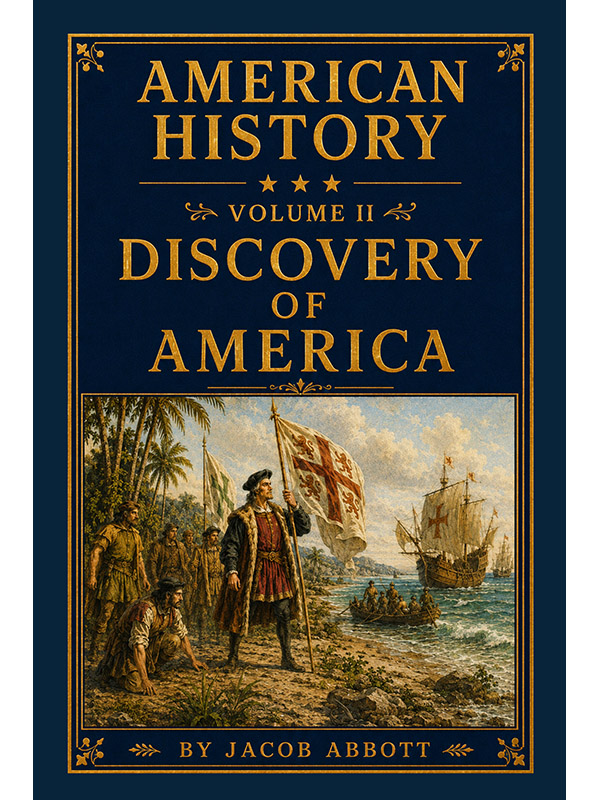
American History: Volume II—Discovery of America

By Jacob Abbott. Set sail into the age of exploration and discovery in this vivid account of the voyages and adventures that opened the Americas to the European world.

In American History: Volume II—Discovery of America, celebrated historian Jacob Abbott recounts the dramatic era of exploration that transformed the course of world history. Combining vivid storytelling with historical insight, Abbott brings to life the daring navigators, explorers, adventurers, and seafarers who crossed unknown oceans in search of new lands, wealth, trade routes, and glory.

Description

By Jacob Abbott. Set sail into the age of exploration and discovery in this vivid account of the voyages and adventures that opened the Americas to the European world.

In American History: Volume II—Discovery of America, celebrated historian Jacob Abbott recounts the dramatic era of exploration that transformed the course of world history. Combining vivid storytelling with historical insight, Abbott brings to life the daring navigators, explorers, adventurers, and seafarers who crossed unknown oceans in search of new lands, wealth, trade routes, and glory.

Readers journey into the world of fifteenth- and sixteenth-century exploration, following the famous voyages of Christopher Columbus and the expeditions that revealed the existence of continents previously unknown to Europe. The narrative vividly recreates the dangers of ocean travel, the uncertainty of navigation, storms at sea, and the courage required to venture into unexplored waters during an age when much of the world remained a mystery.

Abbott introduces readers to the explorers, monarchs, and rival European powers that competed for influence and territory in the New World. Alongside tales of discovery and adventure are accounts of exploration along the coasts and rivers of the Americas, encounters with indigenous peoples, and the beginnings of European settlement and empire-building in the Western Hemisphere.

Themes of curiosity, ambition, courage, exploration, and cultural encounter run throughout the narrative, offering readers insight into one of the great turning points in global history. Written in Abbott’s clear and engaging style, the book transforms complex historical developments into an accessible and compelling story suitable for younger readers and general audiences alike.

More than a history of voyages, Discovery of America is a portrait of an age driven by exploration, innovation, and the desire to expand the boundaries of human knowledge. This carefully restored reprint revives a classic historical volume for modern readers interested in exploration, early America, and the beginnings of the modern world.

About the author: Jacob Abbott (1803–1879) was an American educator, historian, and prolific writer best known for his popular biographies and historical works for general readers and young audiences. He authored hundreds of books, including the celebrated Makers of History series, helping introduce generations of readers to world history through lively and accessible storytelling.


Contents

CHAPTER 1: GREENLAND

A Connecting Link between the Old World and the New.—The Medusae.—Neither Day nor Night.—Ice Produced upon the Land.—Formation of Icebergs.—Ice Formed upon the Sea.—Currents in the Northern Seas.—The First Recorded Migration to America.—Establishment of the Danish Colony.—Disasters.—Voyage of Lief and Biorn.—Different Opinions in Respect to These Discoveries.—The Runic Inscription

CHAPTER II: COLUMBUS

Adventurous Spirit of the Fifteenth Century.—Desire for a Passage to India by Sea.—Two Routes to Be Tried.—Prince Henry of Portugal.—Discovery of the Passage Round the Cape of Good Hope.—Ideas of Christopher Columbus.—Supposed Magnitude of the Earth.—Difficulties Encountered By Columbus.—Terms of the Covenant.—Preparations for the Voyage.—Instruments of Navigation.—Public Opinion in Respect to the Expedition.—The Day of Sailing

CHAPTER III: JOURNAL OF THE FIRST VOYAGE OF COLUMBUS

The Run to the Canary Islands.—A Month at the Canaries.—The Voyage Commenced in Earnest at Last.—Variation of the Needle.—Mid-Ocean.—False Cry of Land.—Prosperous Continuation of the Voyage.—The Mutiny.—Discovery of Land

CHAPTER IV: SEQUEL OF THE VOYAGE

Preparations for Landing.—The Ceremony of Taking Possession.—Forming Acquaintance with the Natives.—Columbus not Satisfied.—Astonishment of the Natives.—Cruise among the Islands.—Search for Spices.—Landing upon Cuba.—An Embassage Sent into the Exterior.—General Treatment of the Natives.—Kidnapping the Natives.—Visit from a Cazique.—Disasters.—Consequences of the Loss of the Sancta Maria.—Conclusion of the Voyage

CHAPTER V: DISCOVERY OF NORTH AMERICA

Sebastian Cabot.—The Cabot Family.—General Interest Awakened in Columbus’s Discoveries.—The Letters Patent.—The Old Map at Whitehall.—The Inscription on the Map.—Other Sources of Information.—The First Voyage.—The Second Voyage.—Observations on the Land.—Advance to the Northward.—Mutiny.—Return of the Expedition.—Subsequent History of Cabot.—The Voyage of the Serchthrift

CHAPTER VI: THE DISCOVERY OF FLORIDA

Universal Interest Awakened.—Americus Vespucius.—John Ponce de Leon and the Fountain of Youth.—Commencement of Hostilities with the American Indians.—The First Act of Revenge.—Narvaez.—The Landing.—Plans for Advancing into the Country.—Progress of the March.—Crossing the Suwanee River.—The Bloodhounds.—Increasing Difficulties.—Arrival at Apalache.—Narvaez Turns His Course toward the Sea.—Narvaez Discouraged.—Boat Building on the Seashore.—End of the Expedition

CHAPTER VII: FERNANDO DE SOTO

Commencement of De Soto’s Career.—Outfit of De Soto’s Expedition.—Difficulties at the Outset.—Arrival on the Coast of Florida.—De Soto Obtains an Interpreter.—The Story of Ortiz.—Preparations for the Campaign.—The Adventure of Vasco Porcallo.—Disposition of the Fleet.—Commencement of the March into the Interior.—Hardships and Difficulties of the March.—Intense Hostility of the Indians.—Progress of the Expedition.—The Captive Princess.—Tuscaloosa.—Approach to Mauvila.—Terrible Reverse at Mauvila.—Horrible Condition of the Army after the Battle.—De Soto’s Determination.—The Greatest of the Losses from the Fire

CHAPTER VIII: DISCOVERY OF THE MISSISSIPPI RIVER

Determination of De Soto to Proceed.—Passage of the Tuscaloosa River.—John Ortiz as an Interpreter.—De Soto Unhorsed in Battle.—The Only Woman in the Army.—Single Combat.—Language of Signs.—Arrival on the Banks of the Mississippi.—Aspect of the River.—Search for a Crossing Place.—A Fleet of Canoes.—Crossing the Mississippi.—Grand Religious Ceremony.—Incidents of the March.—De Soto Begins to be Discouraged.—Determination to Turn toward the Sea.—Sickness and Death of De Soto.—The Burial of the Body.—Condition of the Army after the Death of De Soto.—Case of a Deserter.—End of the Expedition

CHAPTER IX: THE RIVER ST. LAWRENCE

The Three Chief Rivers of North America.—James Cartier.—Sailing of the Expedition.—The Voyage.—Search for a Passage through the Land.—Intercourse with the Natives.—The Expedition Ascends the River.—Donnacona.—Accounts of Hochelaga.—Attempt to Frighten Cartier by an Apparition.—Continued Ascent of the River.—Lake St. Peter.—Approach to Hochelaga.—Visit to the Town.—First Observation of Tobacco.—Return of the Expedition down the River.—The Pestilence.—Extreme Distress and Suffering.—Stratagems against the Indians.—Return of the Expedition.—The Kidnapping of Donnacona.—Donnacona’s Cunning.—The Seizure Effected.—Distress of the People.—Provisions for Donnacona’s Voyage.—Results of Cartier’s Discoveries

CHAPTER X: THE HUDSON RIVER

Henry Hudson.—First and Second Voyages of Hudson.—The Third Voyage.—Landing in Penobscot Bay.—The Ship Blown Ashore.—The Indians.—John Coleman.—Ascent of the River.—Intercourse with the Indians.—An Indian Put to the Test.—Modesty of the Women.—Approach to the Highlands in Descending the River.—An Indian Chief.—End of the Voyage in the River.—Subsequent History of Hudson.—Henry Greene.—The Gunner’s Gray Cloth Gown.—The Captain Quarrels with Greene.—The Mutiny.—The Last That was Ever Known of Captain Hudson.—Conclusion