
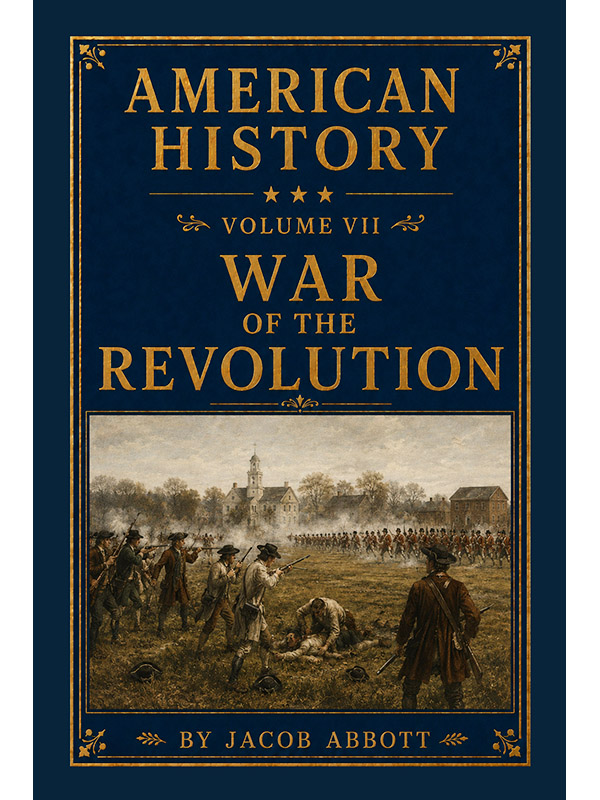
American History: Volume VII—War of the Revolution

By Jacob Abbott.  Experience the dramatic struggle that gave birth to the United States in this vivid account of courage, sacrifice, and revolution.

In American History: Volume VII—War of the Revolution, celebrated historian Jacob Abbott recounts the epic conflict through which the American colonies fought for independence from Great Britain. Combining vivid storytelling with historical insight, Abbott brings to life the battles, hardships, political struggles, and heroic figures that shaped one of the most important wars in modern history.

Description

By Jacob Abbott.  Experience the dramatic struggle that gave birth to the United States in this vivid account of courage, sacrifice, and revolution.

In American History: Volume VII—War of the Revolution, celebrated historian Jacob Abbott recounts the epic conflict through which the American colonies fought for independence from Great Britain. Combining vivid storytelling with historical insight, Abbott brings to life the battles, hardships, political struggles, and heroic figures that shaped one of the most important wars in modern history.

Readers are transported into the turbulent world of eighteenth-century America, where colonial resistance grew into full-scale revolution. The narrative vividly recreates the atmosphere of wartime America, from the opening clashes at Battles of Lexington and Concord to the final triumph at Siege of Yorktown. Battles, military campaigns, winter encampments, political debates, and acts of courage unfold against the backdrop of a people struggling to secure liberty and self-government.

Abbott introduces readers to the great personalities of the Revolutionary era, including George Washington, Thomas Jefferson, Benjamin Franklin, and many others whose leadership and determination guided the colonies through war and uncertainty.

Themes of patriotism, perseverance, sacrifice, leadership, and the desire for freedom run throughout the narrative, offering readers insight into the ideals and struggles that shaped the founding of the United States. Written in Abbott’s clear and engaging style, the book transforms complex military and political events into an accessible and compelling story suitable for younger readers and general audiences alike.

This carefully restored reprint revives a classic historical volume for modern readers interested in the American Revolution, early American history, and the dramatic fight for independence that changed the course of world history.

About the author: Jacob Abbott (1803–1879) was an American educator, historian, and prolific writer best known for his popular biographies and historical works for general readers and young audiences. He authored hundreds of books, including the celebrated Makers of History series, helping introduce generations of readers to world history through lively and accessible storytelling.


Contents

CHAPTER I: The Continental Congress: Virginia and Massachusetts.—Difficulties in the Way of Forming Any Union of the Colonies.—Liability to a Charge of Treason.—Appointment of Committees of Correspondence.—Organization of the Continental Congress.—Professed Object of the Proposed Congress.—Appointment of Delegates to the Congress by the Other Provinces.—Place of Meeting of the First Congress.—First Meeting of the Members.—Organization of the Congress.—Closed Doors.—Solemnity of the Scene at the Opening of the Session.—Patrick Henry.—Principle of Representation Adopted.—Question of Opening the Session with Prayer.—The First Prayer in Congress.—Difference of Opinion among the Members in Respect to the Course to be Pursued.—Final Decision of the Congress.—An Appeal to Arms Conditionally Recommended.—Dissolution of Congress.—Immediate Results of the Action of the First Congress.—The Continental Congress.—Parliament Refuses to Receive the Memorial Addressed to It by Congress

CHAPTER II: Expulsion of the British from Boston: The Fall and Winter of 1775.—The Battle of Lexington.—Boston Besieged.—Gradual Organization of the American Army.—State of Things within the Town.—The Compromise.—The Tories.—Ticonderoga and Crown Point.—Secret Expeditions Fitted Out.—Capture of Ticonderoga.—Other Successes on the Lake.—Benedict Arnold.—Meeting of the Second Continental Congress.—Final Appeal to the Government and to the People of England.—Arrangement in Respect to Funds.—Organization of the Army.—Appointment of a Commander-In-Chief.—The Battle of Bunker Hill.—Organization of the Expedition.—The March.—Bunker Hill.—Work during the Night.—The Alarm.—An Assault by Infantry Resolved Upon.—Preparations for the Contest.—The Battle.—The Spectacle.—The Victory.—Long Continuance of the Siege of Boston.—Condition of the American Army.—The Heights of Dorchester.—The Occupation of the Heights Accomplished.—Alarm of General Howe.—Failure of the Attempt to Dislodge the Americans.—The Evacuation of the Town

CHAPTER III: The Declaration of Independence: Progress of Public Opinion.—Lord Dunmore and Virginia.—Result of the Seizure.—Rapid Progress of the Quarrel.—Ravages of Governor Dunmore on the Virginia Coast.—Ravages of the English Ships in Narragansett Bay.—Barbarity of This Mode of Warfare.—Invasion of Canada.—Benedict Arnold.—Progress of the Expedition.—Difficulties and Hardships Encountered by the Expedition.—Final Failure of the Expedition.—Reassembling of the Continental Congress.—Course of the Discussion.—The Declaration.—Nature of the Corrections Made.—Expected Announcement of the Declaration of Independence.—The Liberty Bell.—The Proclamation Made

CHAPTER IV: The Contest at New York: Governor Tryon.—State of Opinion in New York.—Uprising of the People.—King Sears.—Removal of the Cannon from the Battery.—Flight of the Governor.—The Town Occupied by American Troops.—Lord Stirling.—The Americans Fortify the Approaches to New York.—Arrival of General Washington.—Plans and Arrangements of Sir William Howe.—Difficulties of the British Government.—The Hessians.—Excitement Produced in and around the City.—The Mass of the Population Stand Firm.—All Tokens and Symbols of British Authority Removed.—The Leaden Statue of King George.—First Movement of the Ships.—Advance of the Troops upon New York.—Scene at the Landing.—Preparations for the Combat.—Defeat of the American Army.—The Great Fog.—Council of War.—Retreat of the Army across the River.—Fruitless Pursuit of the British.—Advance of the British Men-of-War.—Attempt at Negotiation.—Difficulties and Discouragements.—The British Take Possession of New York

CHAPTER V: Campaign in the Jerseys: The Two Jerseys.—The Environs of New York.—Position of the American Army.—First Movement of General Howe.—Counteractive Movements of Washington.—The Battle of White Plains.—General Howe Returns to the Southward.—Retreat of Washington across the Hudson.—Capture of Fort Washington.—Extremely Discouraging Prospect for the American Cause.—The People Becoming Discouraged.—Lord Cornwallis.—Capture of Fort Lee.—Retreat across the Jerseys.—Measures for Recruiting the Army.—Situation of the British Army.—A Christmas Surprise.—The Crossing.—Almost a Discovery.—The Surprise.—Return of the Force across the River.—Effect of This Victory upon the Country.—The Battle of Princeton.—Moderation in Victory.—An Unexpected Supply of Warm Clothing.—Encampment at Morristown.—Increase of Public Confidence in Washington.—The Malcontents

CHAPTER VI: The Expedition of Burgoyne: The Avenue to Canada.—General Burgoyne.—The Rendezvous.—Indian Allies.—A Proclamation.—Excitement and Alarm among the Americans.—Capture of the Lake Champlain Forts.—Pursuit of the Americans.—Continued Retreat of the Americans.—Excitement in Congress and throughout the Country.—Brief Occupation of Fort Edward.—Expedition into Vermont.—Preparations in Vermont and New Hampshire.—Conflict between the Congressional and State Authority.—The Battle of Bennington.—Change in the Fortune of War.—Fort Schuyler.—Summons to Surrender.—Messengers Sent to General Schuyler.—Arnold’s Ruse.—Hon-Yost.—General Burgoyne’s Difficulties Become Serious.—Jenny M’Crea.—The Capture.—Account Given by the Indians.—Effects Produced by the Death of Poor Jenny

CHAPTER VII: The Surrender of Burgoyne: The Crisis Approaching.—The Battle of Bemis’s Heights.—Battle of Stillwater.—Death and Burial of General Fraser.—Lady Harriet Ackland.—The Capture of Major Ackland.—General Burgoyne’s Letter to General Gates.—Down the River in a Boat.—Baroness Riedesel.—Hardships and Sufferings of the Baroness.—The Baroness Riedesel’s Journey.—Burgoyne’s Last Council of War.—The Surrender.—March of the Captured Troops to Boston.—Sequel of the Story of Lady Ackland.—Effect of the Surrender of Burgoyne.—Recognition of American Independence by France

CHAPTER VIII: Occupation of Philadelphia: A Serious Reverse.—Expedition Sent to Philadelphia.—Landing of the Expedition.—The Proclamation.—Advance of Washington.—The Battle of Brandywine.—The Battle of Germantown.—The Delaware Forts.—The First Attacks Repulsed.—Final Reduction of the Forts.—Withdrawal of the American Army.—Destitute Condition of the Troops.—The Darkest Period of the Revolution.—The Encampment at Valley Forge.—Alarm of the English Government.—Too Late.—Evacuation of Philadelphia.—The Battle of Monmouth.—Re-Possession of Philadelphia.—Arnold a Bad Boy.—Arnold a Good Soldier.—His Marriage.—Arnold’s Pecuniary Difficulties.—His Final Plan.—The Negotiation.—The Meeting.—Andre Becomes a Spy.—Conclusion of the Story.—Execution of Major Andre.—Arnold

CHAPTER IX: The War at the South: Return from a Digression.—General Condition of the Southern Country.—Charleston and Savannah.—Expedition of 1778.—Preparations of the Americans.—Excitement in Savannah.—The Opposing Forces Confront Each Other.—A Stratagem.—The Capture of Savannah.—Retreat of the American Army.—The State Entirely Subdued.—Attack upon Charleston Repulsed.—A New and Grand Expedition Organized.—Stormy Passage of the Fleet.—Slow Advance of the Army.—Embarrassment Occasioned by the Slaves.—The Siege.—The Terms Offered.—The Bombardment.—The Surrender.—Complete Subjugation of the Southern Provinces

CHAPTER X: Peace: The French Alliance.—Difficulties.—Lafayette.—Advance of Lord Cornwallis.—The Position.—Washington.—Difficulties.—Maneuvering of the Fleets.—The Siege.—The Surrender.—Consequences of the Surrender of Cornwallis.—Peace