When the Second Anglo-Boer War began in October 1899, Jacoba Elizabeth de la Rey could scarcely have imagined how profoundly it would change her family’s life. Known as Nonnie, she was the wife of General Jacobus Herculaas (Koos) de la Rey, one of the best-known Boer commanders of the war. Yet her own account of the conflict is concerned less with military campaigns than with the experiences of a mother struggling to protect her family amid the destruction and uncertainty of war.
Born Jacoba Elizabeth Greeff in 1856, she married Koos de la Rey in 1876. The couple made their home in the Lichtenburg district of the Transvaal, where they raised their twelve children. When war broke out between Britain and the two Boer republics—the South African Republic and the Orange Free State—her husband and two of her sons, Adrian and Jacobus, departed with the Boer forces. For Nonnie, the war brought prolonged separation from family members and increasing uncertainty about their safety.
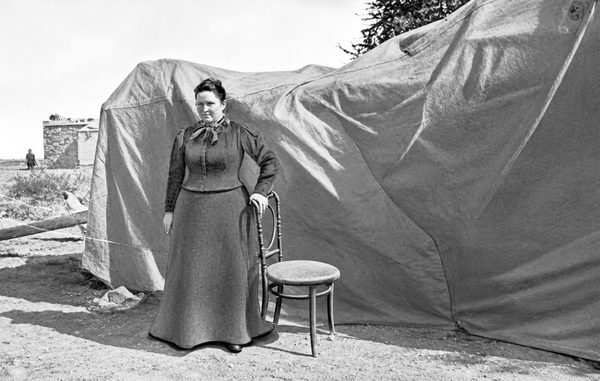
Jacoba Elizabeth (Nonnie) de la Rey beside her covered wagon.
A Family Divided by War.
One of the earliest tragedies Nonnie records was the death of her son Adrian, who was nineteen years old. After receiving a telegram informing her that he had died from wounds sustained in battle, she travelled to join her husband near the fighting.
At Jacobsdaal, she visited Adrian’s grave and the hospital where he had died. She also searched among the clothing of the dead, hoping to recover something that had belonged to him. His father found the trousers Adrian had been wearing, identifiable by the bullet hole.
Her grief was profound, but she drew consolation from her Christian faith. “It was heartrending for me, but there is comfort to be found at the feet of Jesus,” she wrote.
Confrontations with British Officers.
As British forces advanced into the Boer republics, Nonnie found herself dealing directly with occupying troops. Soldiers searched her home, livestock was taken, and the security of her family became increasingly uncertain.
One particularly revealing incident concerned two horses that remained in her possession. One had belonged to Adrian, and she was determined not to lose it.
When British troops attempted to requisition the animals, she insisted on speaking personally to Lord Methuen. She explained that she had already lost nearly all her cattle and pleaded that the horse belonging to her dead son be spared.
According to her memoir, Methuen took her hand and assured her that it would not be taken.
The episode is characteristic of her narrative, which records not only hostility and hardship but also occasional acts of consideration between people on opposing sides.
Eighteen Months on the Veldt.
In December 1900, after being ordered to leave Lichtenburg, Nonnie departed with her children, a wagon, a carriage, and the livestock she could still take with her. She did not know where her travels would end or whether she would ever return home.
For the remainder of the war, she moved through the western Transvaal, frequently forced to abandon temporary shelter as British troops approached.
Her wagon became both a means of transport and a home. She describes travelling over difficult terrain, crossing rivers, enduring storms, and struggling to find food and suitable places to rest. On one occasion, while fleeing advancing troops in heavy rain, her wagon became stuck in the mud. Boer soldiers helped pull it free despite the danger of being overtaken.
At other times, she found shelter in deserted buildings or stayed briefly with families who offered assistance. Her account also records the destruction of farms and livestock, the difficulties of obtaining provisions, and the constant fear of capture.
Throughout these experiences, her religious convictions remained central to her outlook. Reflecting on the months spent travelling in her wagon, she wrote:
“For in my darkest and most anxious nights never did I fail to put my trust in the Lord, and never did His guidance forsake me.”
Her faith was more than a source of personal consolation. It shaped the way she understood the hardships she endured and gave her confidence in the face of an uncertain future.
A Civilian Perspective on the War.
The Second Anglo-Boer War, which ended in May 1902, is often remembered through its battles, commanders, and political consequences. Yet its effects on civilians were devastating. Farms were destroyed, families were displaced, and thousands of women and children died in British concentration camps.
Nonnie de la Rey’s memoir offers a different perspective on these events. Although her position as a general’s wife was unusual, many of the hardships she describes were shared by other Boer families.
Her account also reflects the political loyalties and social attitudes of her time. As with any personal memoir, it presents events through the experiences and convictions of its author, making it valuable both as a record of wartime suffering and as evidence of how that suffering was understood by those who endured it.
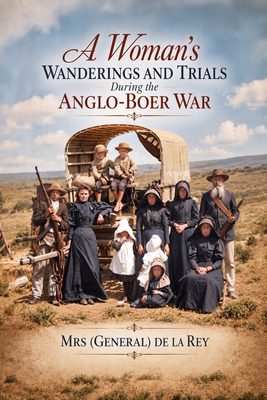
First published in Dutch in 1903 and translated into English the same year by Lucy Hotz, A Woman’s Wanderings and Trials During the Anglo-Boer War preserves the experiences of a woman whose life was transformed by conflict.
This newly published edition includes a new historical introduction, an author biography, restored original illustrations, additional historical images, and explanatory footnotes to help readers understand the people, places, and terminology of the period.