Description
By Jacob Abbott. Witness the dramatic birth of a nation in this vivid account of rebellion, war, and revolution during the struggle for American independence.
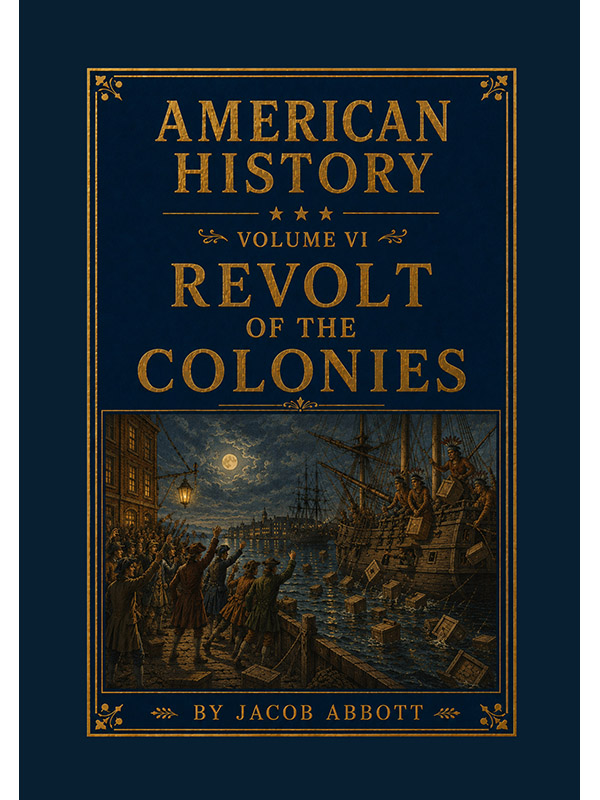
In American History: Volume VI—Revolt of the Colonies, celebrated historian Jacob Abbott recounts the turbulent events that transformed Britain’s American colonies into the independent United States of America. Combining vivid storytelling with historical narrative, Abbott brings to life the political tensions, military conflicts, and revolutionary ideals that shaped one of the most important turning points in modern history.
Readers are transported into the growing crisis between Great Britain and the thirteen colonies as disputes over taxation, representation, and imperial authority escalated into open resistance. The narrative vividly recreates dramatic events such as the Boston Tea Party, the battles of Battles of Lexington and Concord, and the long struggle of the American Revolutionary War.
Abbott introduces readers to the great personalities of the Revolutionary era, including George Washington, Thomas Jefferson, Benjamin Franklin, and many others whose leadership and ideas helped shape the emerging republic. Battles, political debates, diplomacy, hardship, and sacrifice unfold against the backdrop of a people fighting to secure independence and self-government.
Written in Abbott’s clear and engaging style, the book transforms complex historical events into an accessible and compelling narrative suitable for younger readers and general audiences alike. Themes of liberty, courage, political principle, and national identity run throughout the work, making it both educational and inspiring.
This carefully restored reprint revives a classic historical volume for modern readers. Ideal for students, lovers of American history, and readers interested in the Revolutionary era, Revolt of the Colonies remains a timeless introduction to the founding struggle of the United States.
About the author: Jacob Abbott (1803–1879) was an American educator, historian, and prolific writer best known for his popular biographies and historical works for general readers and young audiences. He authored hundreds of books, including the celebrated Makers of History series, helping introduce generations of readers to world history through lively and accessible storytelling.
Contents
CHAPTER I: Principles of Government: Divergency of European and American Ideas.—The Natural Origin of Government.—No Other Government Possible in the Early Stages of Society.—Nature and Origin of the Civil Liberties Enjoyed by the People in Europe.—American Ideas of Government.—Cause of this Diversity.—Origin of Government in America.—The Proprietary Governments.—Early Indifference of the Mother Country in Respect to the Colonies.—Increasing Importance of the Colonies.—Conflicting Claims.—Royal Charters.—Conflicts under the Charter Governors.—Contests in Respect to the Charters.—The Charter Oak at Hartford.—Progress of the Royal Governor.—The Charter Disappears.—The Charter Oak
CHAPTER II: The Mother Country and the Colonies: Relation of the Colonies to the Mother Country.—The Four Great Subjects of Contention.—1.—The Right of the Government to Regulate the Commerce of the Colonies.—The Colonial System.—Double Object to be Secured by This System.—The Colonies Unable to Resist the English Navigation Laws.—2.—The Tenure of Office in the Case of Judges.—3.—The Salaries of the Governors.—The Moderation of the Claim Made by the Colonies.—4.—The Power of Direct Taxation.—The Result, in Practice.—The Time for Direct Taxation Arrives.—Grounds of Resistance on the Part of the Colonies.—Theory of the British Constitution.—Practical Operation of the System.—Watchful Jealousy of Englishmen in Respect to This Power.—Feeling of the American Colonists.—Argument of the British Writers.—The Reply of the Colonists to This Argument.—A Real Representation of the Colonies in Parliament Proposed
CHAPTER III: The Stamp Act: The First Attempted Taxation.—Advantages of the Plan.—Great Excitement in America.—Period When These Transactions Occurred.—The Excitement Does not Subside.—The True Point at Issue.—General Convention Called.—Preparations Made in Boston for Collecting the Tax.—The Liberty Tree.—The Effigies.—Governor Hutchinson.—Plans for Removing the Effigies.—An Open Riot.—Rioting as a Remedy for Wrong.—The Sacking of Hutchinson’s Residence.—Change in Public Opinion.—Riots in Other Places.—Total Failure of the Government to Carry the Act into Effect.—Repeal of the Stamp Act.—Satisfaction and Joy of the Americans
CHAPTER IV: Progress of the Quarrel: The Controversy not Settled by the Repeal of the Stamp Act.—Unfavorable Turn of Affairs in England.—Dispute about the Damages.—Renewed Attempt to Tax the Colonists.—The Idea of the Government.—Preparations for a Contest.—Effect of These Measures in America.—John Hancock.—Samuel Adams.—John Hancock’s Sloop Liberty.—The Circular Letter of Massachusetts.—Occasion of the Circular.—The Question of Independence.—Displeasure of the Ministry with the Circular.—Decision of the Assembly of Massachusetts on the Question of Rescinding.—Address to the Ministry Accompanying the Refusal to Rescind.—Public Opinion in Boston on the Question of Rescinding
CHAPTER V: Military Preparations: Effect of the Dissolution of the Assembly.—A Convention Called.—Action of the Convention.—Rejection of the Two Petitions.—Arrival of Troops.—Landing of the Troops.—Question of Quarters.—Views of the Governor.—The Manufactory House.—A Compromise.—Great Excitement on the Following Day.—The Excitement Continues.—Interposition of General Gage.—The Officers Attempt to Conciliate the Ladies.—Burning of the Jail.—The Commissioners of Customs.—James Otis.—Otis’s Idea of His Position in a Legal Point of View.—Otis Advertises the Commissioners.—Advertisement.—Sir Francis Bernard, of Nettleham, Bart.—Anger of the Commissioners.—Results of the Assault upon Otis.—The Action for Damages
CHAPTER VI: The Middle and Southern Colonies: Opposition to the Measures of the Government General throughout All the Colonies.—Alleged Trivialness of the Causes of the Quarrel.—The Two Great Foundations of English Liberty.—General Effect of These Limitations.—Practical Result in England.—Intentions of the English Government in Respect to America.—Action of Virginia.—Lord Botetourt.—English Ideas of the Display of Pomp and Parade as an Auxiliary of Government.—Pomp and Parade Affected by Lord Botetourt.—Conciliatory Tone Adopted by the Governor in His Opening Message.—The Virginia Resolutions.—The Governor Dissolves the Assembly.—The Example of Virginia Is Followed by All the Southern Colonies.—A Minority Opposed to These Proceedings.—The Lottery Tickets.—The Pride of the Government Forbids Concession.—The Government Finally Yields.—The Colonists Far from Being Satisfied with This Declaration
CHAPTER VII: The Boston Massacre: A Misnomer.—Scene of the Massacre.—Great Increase of Hostile Feeling between the Citizens and the Soldiers.—Collisions between the Soldiers and Citizens in New York.—Tidings of These Occurrences in Boston.—Hostile Feelings toward the Friends and Partisans of the Government.—Commencement of the Difficulty Which Led to the Massacre.—Excitement on Saturday.—Attitude of the Colonial and Military Authorities.—Deliberate Arrangements Made by the Soldiers.—Examples of the Warnings Given.—Great Excitement on Monday Evening.—The Sentinels.—Murray’s Barracks.—Message from King Street.—The Sentinel Sends for Help.—A Corporal and a File of Men.—The Cry of Fire.—The Firing of the Military on the Crowd.—The People of the Custom-House Implicated.—The Result of the Trials.—Scene in the Street after the Firing.—Proceedings during the Night.—Proceedings on the Following Morning.—Meeting of the Governor and Council.—Meeting of Citizens in Faneuil Hall.—Conference with the Governor.—Report of the Committee.—The Demand upon the Governor Renewed
CHAPTER VIII: Popular Outbreaks: Long Protraction of the Preliminary Contest.—Excitement in England Produced by the Boston Massacre.—Resolutions Offered in the House of Commons.—The Ministry Will Not Yield.—Rigorous Measures Adopted.—The North Carolina Regulators.—The Party of the Regulators Increased and Strengthened.—Few—The Leader of the Regulators.—Defeat of the Regulators.—The Sloop Liberty.—Resentment of the People.—The Affair of the Gaspee.—Ineffectual Attempts to Procure Redress.—The Gaspee Runs Aground.—John Brown.—Preparations for an Attack on the Gaspee.—Account Given by One of the Participants in the Affair.—Great Excitement Produced by the Affair.—Royal Commission Appointed.—Aaron Briggs.—Abraham Whipple.—The Boston Tea Party.—Ingenious Contrivance of the British Government for Inducing the Colonies to Submit to be Taxed.—The Plan Does not Succeed.—Another Very Ingenious Scheme Adopted.—Disposition Made of the Tea Sent to the More Southern Ports.—The Boston Consignees Called upon to Resign.—The Meeting at the Liberty Tree.—Subsequent Proceedings.—Town Meeting Called.—Increase of Excitement.—Evening Party at the House of a Consignee.—Flight of the Consignees from the Town.—Arrival of the First Cargo of Tea.—Public Meeting on Monday.—Meeting on Tuesday.—Proclamation from the Governor.—Definite Measures Adopted.—A Fortnight of Suspense and Negotiation.—Difficulties and Complications of the Affair.—Final Effort to Procure a Clearance for the Ship.—Mass-Meeting on the Last Day.—The Afternoon Meeting.—Governor Hutchinson.—The Meeting in the Evening.—Sudden Breaking up of the Meeting.—Destruction of the Tea
CHAPTER IX: The Boston Port Bill: Excitement in England.—The Port Bill.—Period during Which the Harbor of Boston Was to Remain Closed.—Other Measures Adopted for Bringing the Colony under Control.—Remodeling of the Provincial Government.—Provision for Conveying Accused Persons out of the Colony for Trial.—Effect of the Announcement of These Measures in America.—Appointment of a New Governor.—Reception of Governor Gage in Boston.—Arrival of the Intelligence of the Passage of the Port Bill.—Effect of the Intelligence upon the Country at Large.—Arrival of the Fatal Day.—Sympathy of Other Colonies with Massachusetts.—Material Aid for the People of Boston.—Magnanimous Conduct of Salem and Marblehead.—Organization of a Continental Congress
CHAPTER X: War: Preparations.—Open Rupture between Governor Gage and the Massachusetts Legislature.—Vigorous Measures.—Adopted by the Provincial Congress.—Attempts on Both Sides to Secure Arms and Ammunition.—Affair of the Drawbridge at Salem.—A Force Sent by Water.—Preparations for Opposing Their Progress.—A Compromise.—The Battle of Lexington.—The Secret Discovered.—The Result.—The Troops Greatly Harassed on Their Return.—The Result