Description
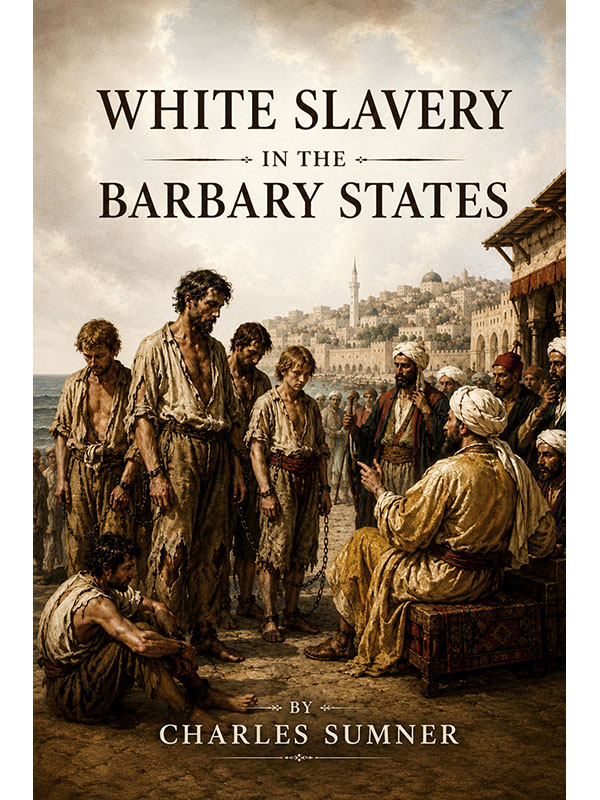
By Charles Sumner. White Slavery in the Barbary States is one of the most remarkable American anti-slavery writings of the nineteenth century. First delivered as a public lecture before the Boston Mercantile Library Association on May 6, 1847, it was later published in book form and quickly attracted wide attention on both sides of the Atlantic. In this work, Charles Sumner examines the long history of the enslavement of Europeans and Americans by the Muslim states of North Africa, commonly known as the Barbary States, which included Morocco, Algiers, Tunis, and Tripoli.
The book recounts how thousands of captives were seized by Barbary corsairs and forced into slavery between the sixteenth and early nineteenth centuries. Sumner describes the conditions endured by these captives, the efforts made to ransom or liberate them, and the broader political and moral questions raised by the institution of slavery. Drawing upon historical records, diplomatic correspondence, and contemporary accounts, he presents a dramatic overview of a system that subjected countless men, women, and children to bondage.
Sumner’s principal purpose was to address the great moral issue of his own age: slavery in the United States. By directing his audience’s attention to the suffering of white captives in North Africa, he sought to demonstrate the universal injustice of human bondage. He argued that if Americans could readily condemn the enslavement of Europeans by foreign powers, they should be equally prepared to condemn the enslavement of Africans and their descendants at home.
As a result, White Slavery in the Barbary States formed part of the growing abolitionist and anti-slavery movement that was gathering strength throughout the United States during the 1840s.
Today, the book remains an important historical document—both as an account of the Barbary slave system and as a powerful example of how historical scholarship was employed in the struggle against slavery in nineteenth-century America.
Charles Sumner (1811–1874) was an American statesman, lawyer, and leading opponent of slavery who served as a United States Senator from Massachusetts from 1851 until his death. A prominent voice in the abolitionist movement, he became one of the most influential anti-slavery activists of his era.